
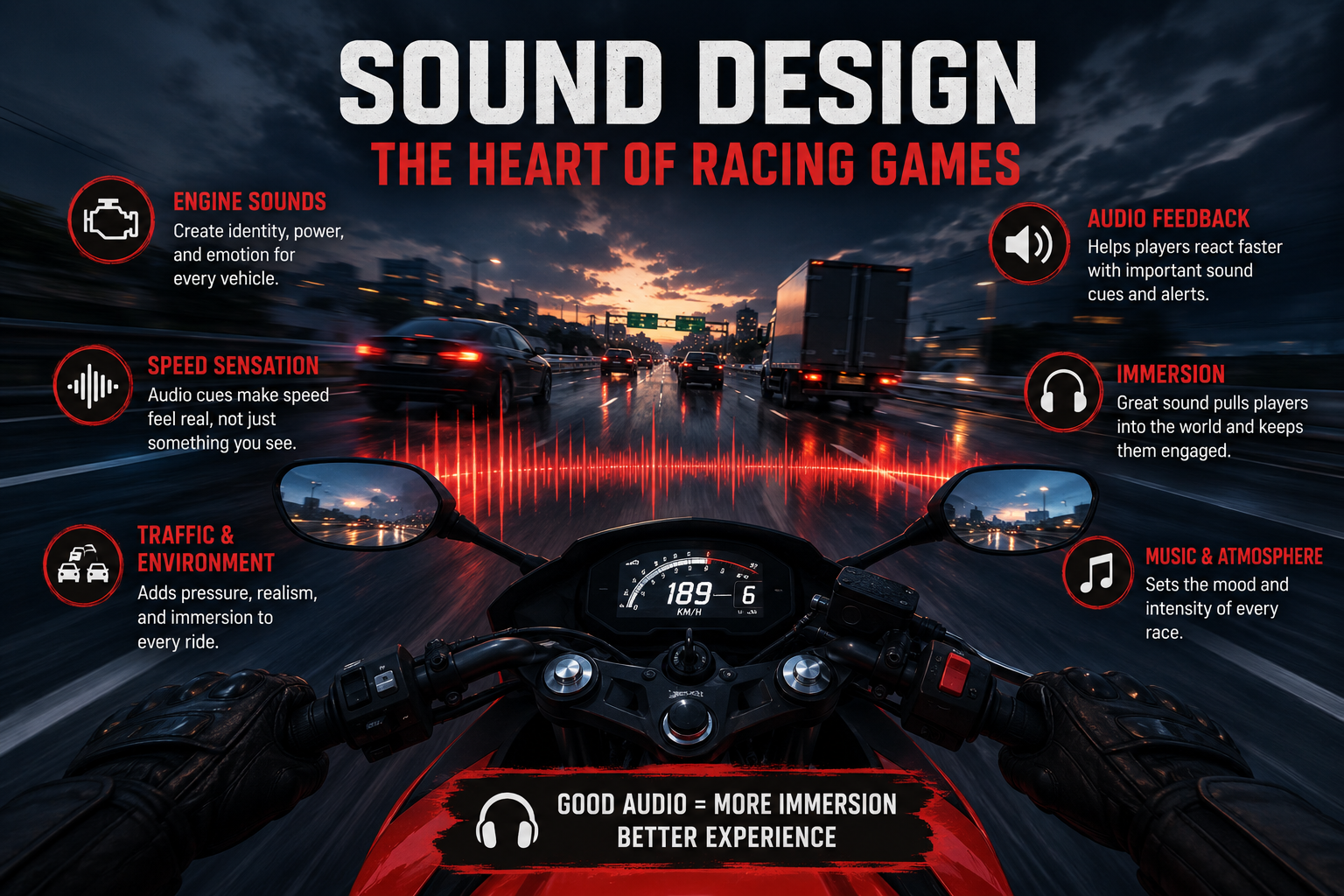
Most players notice graphics first. But in racing games, sound is often what creates the real sense of speed, pressure, and immersion.
A racing game can still feel exciting with average visuals if the engine audio, tire noise, acceleration effects, and environmental sounds feel convincing. On the other hand, even visually impressive racing games can feel strangely lifeless when the audio lacks impact.
In many ways, sound design is what gives speed its emotional weight.
Players Feel Speed Through Audio
Visual motion alone does not fully create the sensation of speed. The brain also depends heavily on sound cues to understand acceleration, intensity, and movement.
Engine pitch changes, wind effects, road noise, and traffic sounds all work together to make players feel like they are actually moving faster.
Without strong audio feedback, racing gameplay can feel flat no matter how realistic the graphics appear.
Engine Sounds Create Emotional Identity
In motorcycle and car racing games, vehicle audio becomes part of the personality of the machine itself. Players often remember how a bike sounds as much as how it looks.
A powerful engine note can make a vehicle feel aggressive, heavy, fast, or unstable before the player even begins racing.
- deep acceleration tones
- high-RPM engine sounds
- gear shift effects
- braking audio feedback
- traffic pass-by sounds
Audio Helps Players React Faster
Sound is not only immersive — it is functional. Many players subconsciously rely on audio to time braking, lane changes, overtakes, and acceleration.
Good racing games use audio cues to communicate danger, speed changes, collisions, and nearby traffic without forcing players to constantly look at interface elements.
This becomes especially important on smartphones where screen space is limited.
Silence Makes Racing Feel Artificial
One reason weak audio stands out so quickly in racing games is because driving naturally produces constant noise. Roads, engines, wind, vibrations, and traffic all create continuous sensory information in real life.
When those layers are missing inside a game, the experience immediately feels less believable.
| Sound Element | Gameplay Effect |
|---|---|
| Engine pitch | Creates speed sensation |
| Traffic audio | Increases tension |
| Braking sounds | Improves reaction timing |
| Environmental noise | Adds immersion |
Mobile Players Often Use Headphones
Unlike console gaming, mobile gaming is frequently experienced through headphones. This makes sound design even more important because audio becomes more direct and personal.
Detailed engine effects and spatial sound can dramatically improve immersion during short mobile gaming sessions.
Music Also Shapes The Experience
Background music plays a major role in defining the emotional tone of racing games. Fast electronic tracks, aggressive beats, or cinematic music can completely change how players perceive gameplay intensity.
Some racing games intentionally use minimal music during gameplay to let engine and road sounds dominate the experience instead.
Graphics Alone Cannot Carry Racing Games
Visual quality still matters, but racing games rely heavily on sensory balance. Speed is not something players simply see — it is something they hear and feel through layered audio feedback.
That is why strong sound design often has a bigger impact on immersion than graphical detail alone.
Conclusion
Sound design matters so much in racing games because audio shapes speed, tension, reaction timing, and emotional intensity throughout every race.
For many players, the sound of the engine, the rush of traffic, and the pressure of acceleration are what truly make racing games feel alive.