
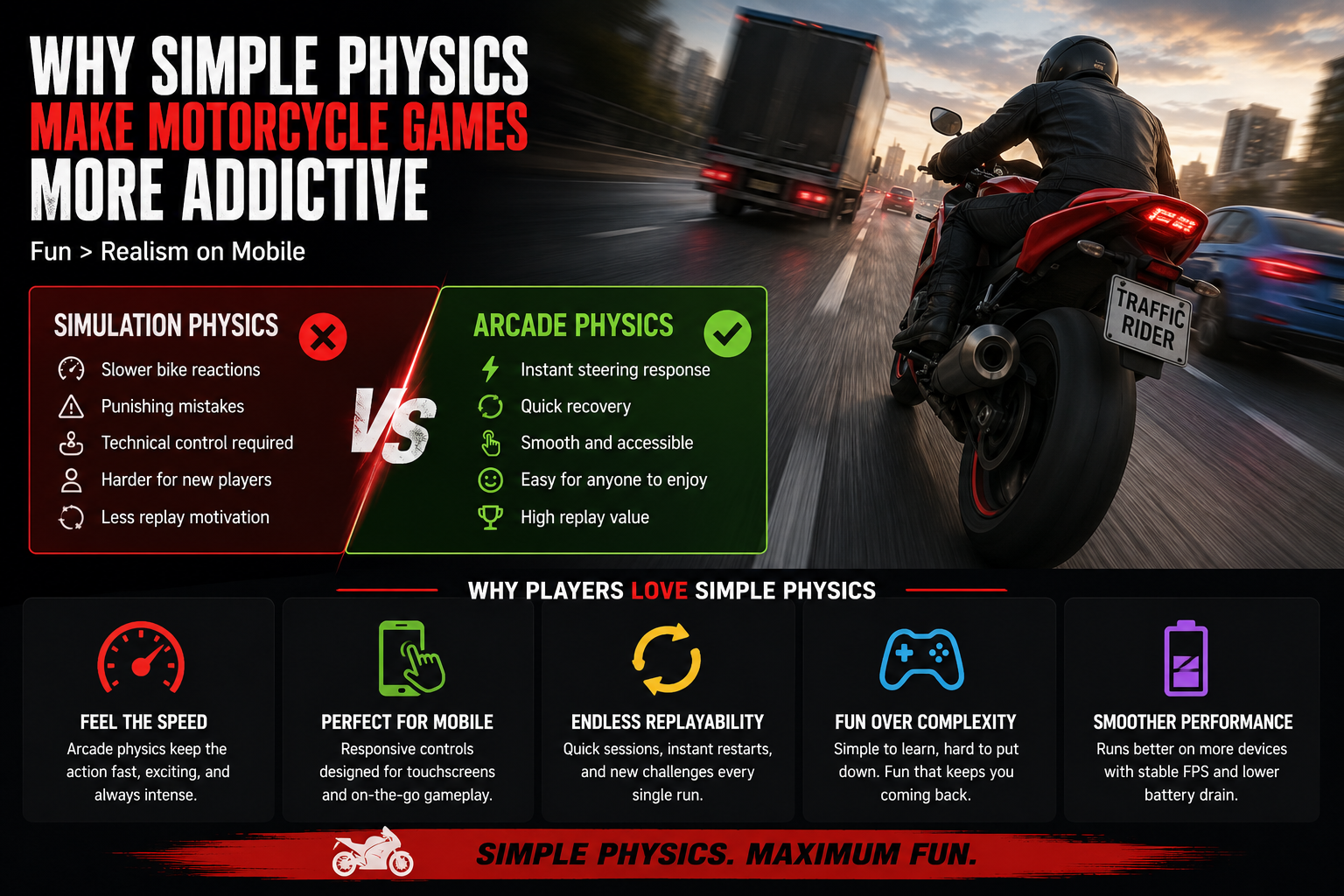
For years, racing developers believed realism automatically created better gameplay. More advanced physics, heavier bike handling, realistic crashes, and simulation mechanics were treated as signs of quality. But mobile motorcycle gaming evolved differently.
Many of the most replayed bike games today still rely on simplified physics systems rather than full simulation realism. And surprisingly, that often makes them more enjoyable for everyday players.
Perfect Realism Often Feels Too Heavy on Mobile
Realistic motorcycle physics can look impressive, but they also create friction. Heavy turning, realistic braking distance, unstable handling, and punishment for small mistakes may work well for hardcore simulators, but mobile players usually expect something smoother and faster.
Most users open motorcycle games for quick excitement, not for technical riding accuracy. That’s why simpler handling systems continue dominating mobile racing.
Arcade Physics Create Better Flow
One major reason simplified physics feel addictive is gameplay rhythm. Arcade-style movement creates a continuous sensation of momentum. Players drift through traffic smoothly, recover quickly after mistakes, and maintain speed longer.
That flow state becomes extremely satisfying during repeated sessions. In contrast, highly realistic simulations often interrupt pacing constantly with stricter control demands.
Mobile Players Prefer Responsiveness Over Accuracy
Touchscreens naturally limit precision compared to controllers or steering setups.
Because of that, developers often intentionally simplify physics to make gameplay feel more responsive.
| Simulation Physics | Arcade Mobile Physics |
|---|---|
| Slower bike reactions | Instant steering response |
| Punishing mistakes | Faster recovery systems |
| Technical braking control | Smoother acceleration focus |
| Higher realism | Higher accessibility |
| Long learning curve | Immediate gameplay comfort |
That difference shapes long-term replayability heavily.
Speed Feels More Important Than Accuracy
Many successful mobile motorcycle games understand something important: perceived speed matters more than realistic simulation. Motion blur, fast lane changes, close overtakes, and rapid environmental movement create excitement instantly.
Players emotionally remember intensity far more than realistic tire physics. That’s why many highway racers intentionally exaggerate speed sensation rather than pursuing perfect realism.
Simpler Physics Reduce Frustration
Mobile gaming sessions are usually short. If players crash constantly because controls feel overly technical, frustration builds quickly. Many users simply uninstall the game rather than “learn the system.”
Arcade physics reduce that barrier significantly. Players feel skilled much earlier, which increases confidence and replay motivation.
Replayability Matters More Than Simulation Depth
One reason endless highway racers continue surviving for years is replay simplicity.
The gameplay loop remains instantly understandable:
- avoid traffic
- maintain speed
- survive longer
- improve score
- restart quickly
Simplified physics support that loop perfectly because players can immediately jump back into action after every run.
Even Console Games Sometimes Use Arcade Logic
Interestingly, many modern racing games secretly simplify realism more than players realize. Even visually realistic titles often modify handling systems intentionally to maintain fun and accessibility.
Developers understand that completely realistic motorcycles can become frustrating very quickly — especially for casual audiences. Mobile games simply push that philosophy further.
Hardware Limitations Also Influence Design
Advanced simulation systems require more processing power and constant calculation.
On smartphones, simpler physics often help:
- maintain stable framerates
- reduce battery usage
- improve responsiveness
- support weaker devices
That technical stability matters more than many players consciously notice.
Why Simpler Motorcycle Games Keep Winning
Mobile racing audiences continue showing the same pattern repeatedly: smooth gameplay beats technical realism for most users. Players want motorcycle games that feel fast, responsive, and instantly enjoyable without demanding huge concentration levels.
And while realistic simulation games will always have dedicated fans, simpler arcade physics continue proving far more effective for long-term mobile engagement.