
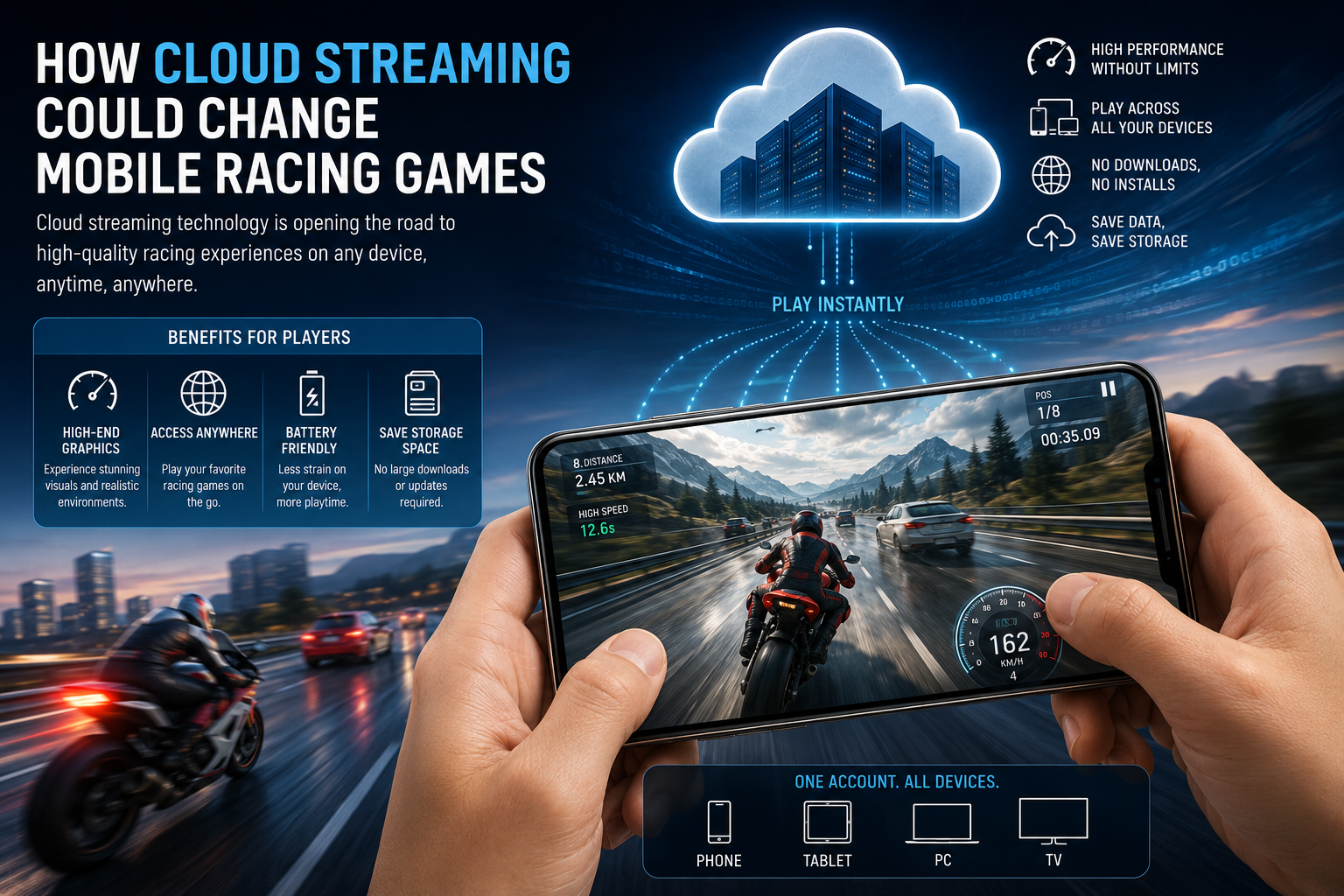
For years, mobile racing games have been limited by the hardware inside smartphones and tablets. Developers have worked around processing power, storage limitations, battery consumption, and device fragmentation to deliver increasingly impressive racing experiences. Cloud streaming may change that equation entirely.
Instead of running a game directly on a device, cloud gaming allows most of the processing to happen on remote servers. The player’s phone simply receives a video stream while sending control inputs back to the server. Although cloud gaming is still developing, many industry observers believe it could significantly influence the future of mobile racing games.
As internet infrastructure improves worldwide, developers are beginning to explore how streaming technology could unlock new possibilities for racing experiences on mobile devices.
What Is Cloud Streaming?
Cloud streaming allows games to run on powerful remote hardware instead of relying on local device performance.
The process works as follows:
| Traditional Mobile Gaming | Cloud Streaming |
|---|---|
| Game runs on device | Game runs on remote server |
| Limited by phone hardware | Uses data center hardware |
| Requires large downloads | Instant access possible |
| Battery-intensive processing | Lower local processing load |
| Device-specific performance | Consistent performance potential |
For players, the experience can feel similar to watching a live video stream while interacting in real time.
Why Racing Games Could Benefit More Than Other Genres
Not every game genre benefits equally from cloud technology. Racing games are particularly demanding because they often require:
- Detailed environments.
- High frame rates.
- Long draw distances.
- Complex lighting systems.
- Advanced vehicle models.
These features place heavy demands on mobile hardware. Cloud streaming could allow developers to create larger worlds and more visually ambitious racing experiences without requiring users to own flagship smartphones.
Hardware Limitations May Become Less Important
One of the biggest challenges in mobile gaming is device fragmentation. Developers must optimize games for hundreds of smartphone models with different processors, memory capacities, and screen configurations.
Cloud streaming could reduce this problem.
| Current Challenge | Potential Cloud Solution |
|---|---|
| Weak processors | Server-side processing |
| Limited storage | Minimal local installation |
| Battery drain | Reduced local workload |
| Performance differences | More consistent gameplay |
| Hardware upgrades | Less dependence on device specs |
This could make advanced racing experiences accessible to a much wider audience.
Larger and More Detailed Racing Worlds
Mobile racing games often need to balance visual quality against performance. Developers frequently reduce environmental complexity to maintain smooth gameplay on lower-end devices.
Cloud-based systems could allow:
- Longer highways.
- Denser traffic systems.
- More detailed cities.
- Larger open-world maps.
- Enhanced environmental effects.
This additional processing power could create racing environments that feel closer to console or PC experiences.
Cross-Device Gaming Could Become Standard
Cloud technology may also simplify the transition between devices. A player could potentially begin a race on a smartphone, continue on a tablet, and later switch to a television without downloading separate versions of the game.
Potential benefits include:
| Feature | Player Advantage |
|---|---|
| Device switching | Seamless gameplay |
| Shared progress | Unified experience |
| Instant updates | Less maintenance |
| Reduced downloads | Faster access |
| Flexible play options | More convenience |
This flexibility could become increasingly attractive as gaming ecosystems continue expanding.
Challenges Still Need To Be Solved
Despite its potential, cloud streaming is not without limitations.
Several obstacles remain:
- Internet latency.
- Network stability.
- Mobile data usage.
- Regional server coverage.
- Streaming costs.
Racing games are particularly sensitive to delays because reaction times are critical. Even small amounts of latency can affect steering precision and overall gameplay quality.
Until internet infrastructure improves further, traditional local gaming will continue playing an important role.
Could Cloud Streaming Become Mainstream?
Cloud gaming has experienced periods of excitement before, but recent technological improvements have renewed industry interest. Faster mobile networks, expanding fiber infrastructure, and more powerful cloud platforms are creating conditions that did not exist a decade ago.
Many analysts believe cloud gaming will not completely replace traditional mobile gaming. Instead, both models may coexist, allowing players to choose experiences that best match their devices and internet connections. For racing games, this hybrid future may provide the greatest flexibility.
Conclusion
Cloud streaming could change mobile racing games by reducing hardware limitations, enabling larger environments, improving graphical quality, and supporting seamless cross-device experiences.
While challenges such as latency and network reliability remain, advances in cloud infrastructure continue pushing the technology forward. If adoption continues growing, cloud streaming may become one of the most important developments shaping the future of mobile racing games over the next decade.